
Publications
Castoria, K. E., et al. “Selective Shuttling of Electrons on Helium Using a CMOS Control Platform.” Physical Review Applied, vol. 26, no. 1, 2026, article 014005, doi.org/10.1103/pq6h-679f.
Abstract
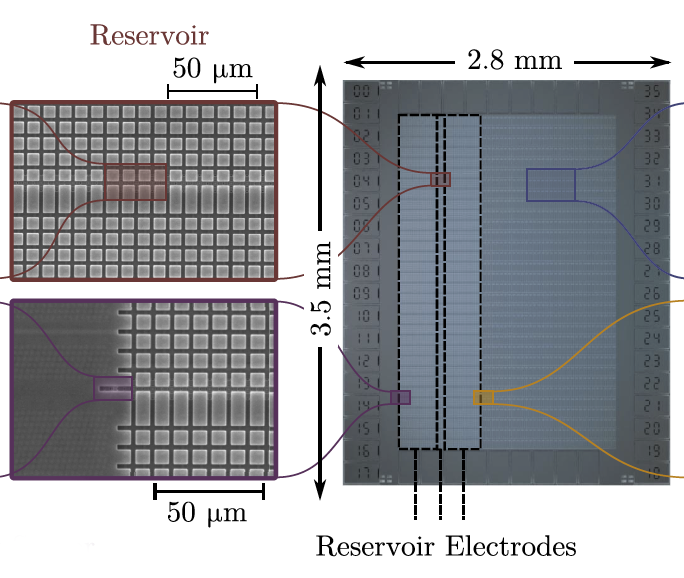
Electrons bound to the surface of liquid helium are an emerging quantum computing platform, offering the potential for highly mobile spin qubits that can be manipulated using complementary metal-oxide-semiconductor (CMOS)-fabricated devices. Here, as a step toward realizing this technology, we demonstrate selective two-dimensional shuttling of electrons across a helium film condensed on the surface of a CMOS control chip. The electrons are moved in packets containing, on average, several tens down to single electrons. We perform CCD-style electron shuttling in any of 128 transport microchannels, each of which links electron storage zones and sensing zones in the two-dimensional plane. This shuttling “unit cell” is repeated 32 times across the chip, allowing packet sensing to be performed in parallel. Despite the resulting gain in sensitivity, we find no evidence of electron loss after repeating shuttling sequences at least 109 times. The device serves as a prototype quantum information processing platform that is readily scalable to control large monolithically integrated arrays of electron spins.
Perruzza, Maria Elena, et al. “Electrons on Helium and Entangled Quantum Sensors for Particle Physics.” arXiv, 30 June 2026, arxiv.org/abs/2606.31910.
Abstract
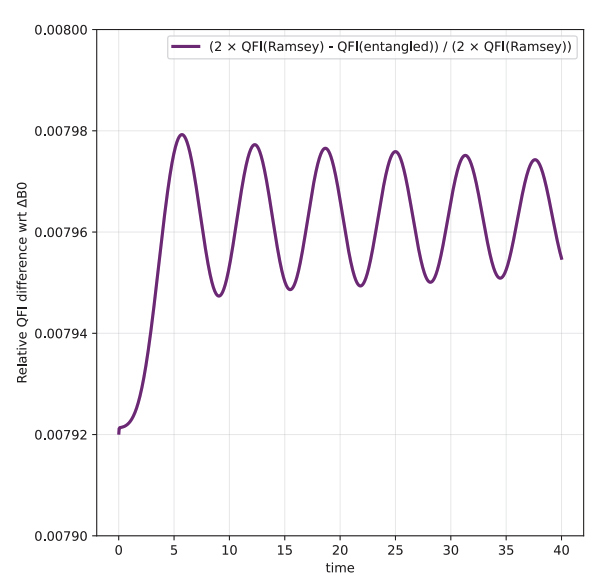
Quantum sensors that harness quantum coherence and entanglement are emerging as powerful tools in many fields, including particle physics, promising unprecedented sensitivity beyond classical detection methods. At the same time, electrons trapped on the surface of liquid helium have emerged as a promising quantum computing, and possibly sensing, platform owing to a nearly impurity-free environment and large predicted coherence times. In this context, single-electron confinement and control using microfabricated traps on helium has been experimentally demonstrated, highlighting the feasibility of scalable qubit architectures on this platform. In line with the DRD5 initiative at CERN, we propose here a sensor concept that uses an entangled pair of electron qubits on superfluid helium for particle physics experiments. We outline the motivation for such spatially and spin-entangled sensors, develop the theoretical formalism for two electrons and their spins and spatial degrees of freedom in a helium-based double-well trap (analogous to a double quantum dot in semiconductor systems), and discuss the potential advantages for detecting rare high-energy events with quantum-enhanced sensitivity. By exploiting quantum entanglement between the two trapped electrons, this sensor concept can surpass classical sensitivity limits, potentially enabling the detection of signals beyond the reach of classical detectors.

Abstract
Electrons bound to the surface of superfluid helium have been proposed as a scalable platform for charge- and spin-based quantum computing. Cavity quantum electrodynamics provides a promising method to implement quantum measurement and control of superfluid helium-bound electrons. In this approach, a cavity amplifies the strength of the interaction between the electron and a single photon for coherent exchange of quantum information and qubit readout. This strong coupling regime has been used for quantum measurement in different platforms such as superconducting qubits, atoms and semiconductor quantum dots. Here we demonstrate strong coupling between a microwave photon and the quantized motional state of a single electron on helium using a device comprising a quantum dot and superconducting resonator. Access to this regime provides a basis for developing single-electron spin qubit readout protocols using spin–orbit hybridization techniques that have already been demonstrated in semiconductor quantum dots.
Abstract
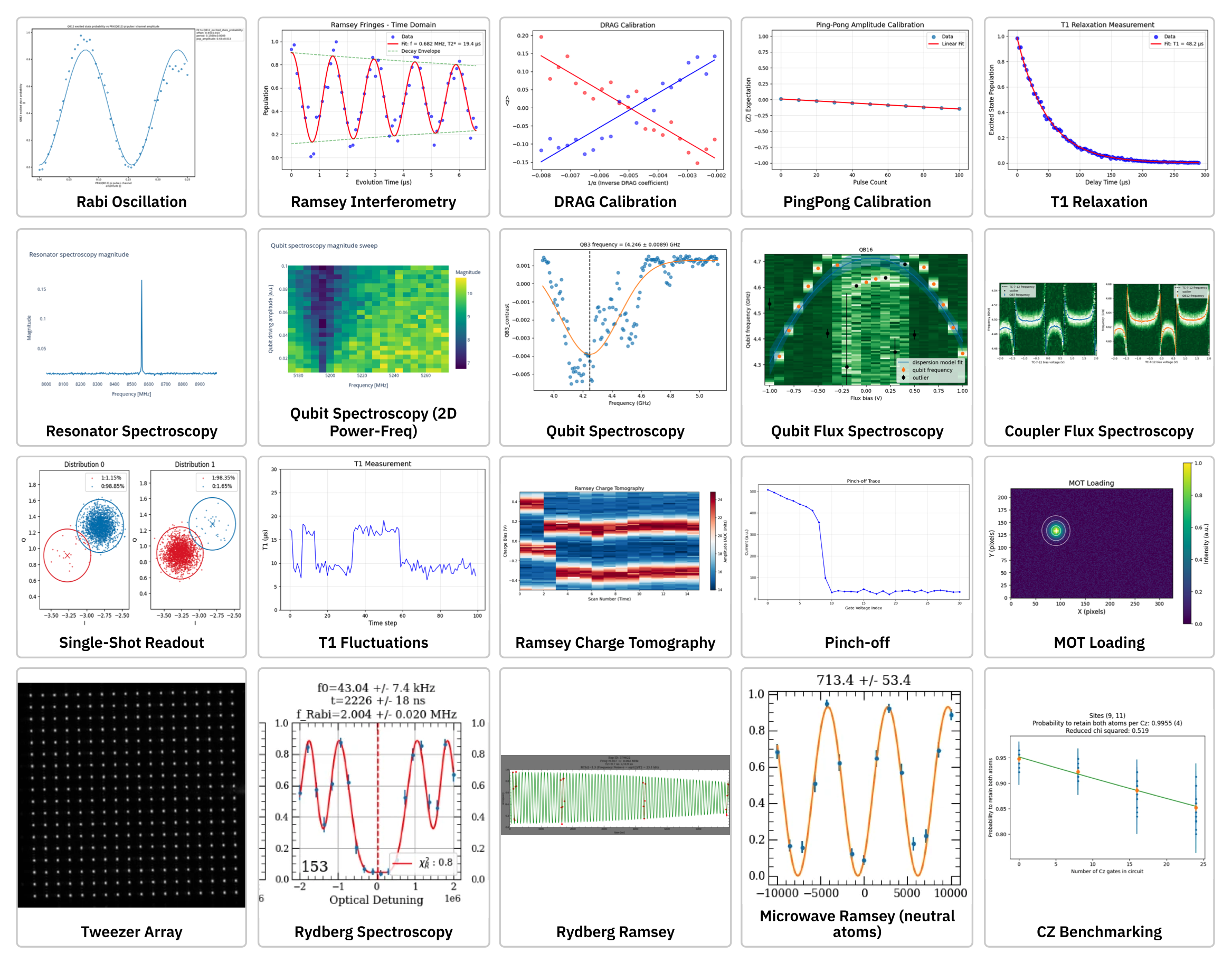
Quantum computing calibration depends on interpreting experimental data, and calibration plots provide the most universal human-readable representation for this task, yet no systematic evaluation exists of how well vision-language models (VLMs) interpret them. We introduce QCalEval, the first VLM benchmark for quantum calibration plots: 243 samples across 87 scenario types from 22 experiment families, spanning superconducting qubits and neutral atoms, evaluated on six question types in both zero-shot and in-context learning settings. The best general-purpose zero-shot model reaches a mean score of 72.3, and many open-weight models degrade under multi-image in-context learning, whereas frontier closed models improve substantially. A supervised fine-tuning ablation at the 9-billion-parameter scale shows that SFT improves zero-shot performance but cannot close the multimodal in-context learning gap. As a reference case study, we release NVIDIA Ising Calibration 1, an open-weight model based on Qwen3.5-35B-A3B that reaches 74.7 zero-shot average score.
Abstract
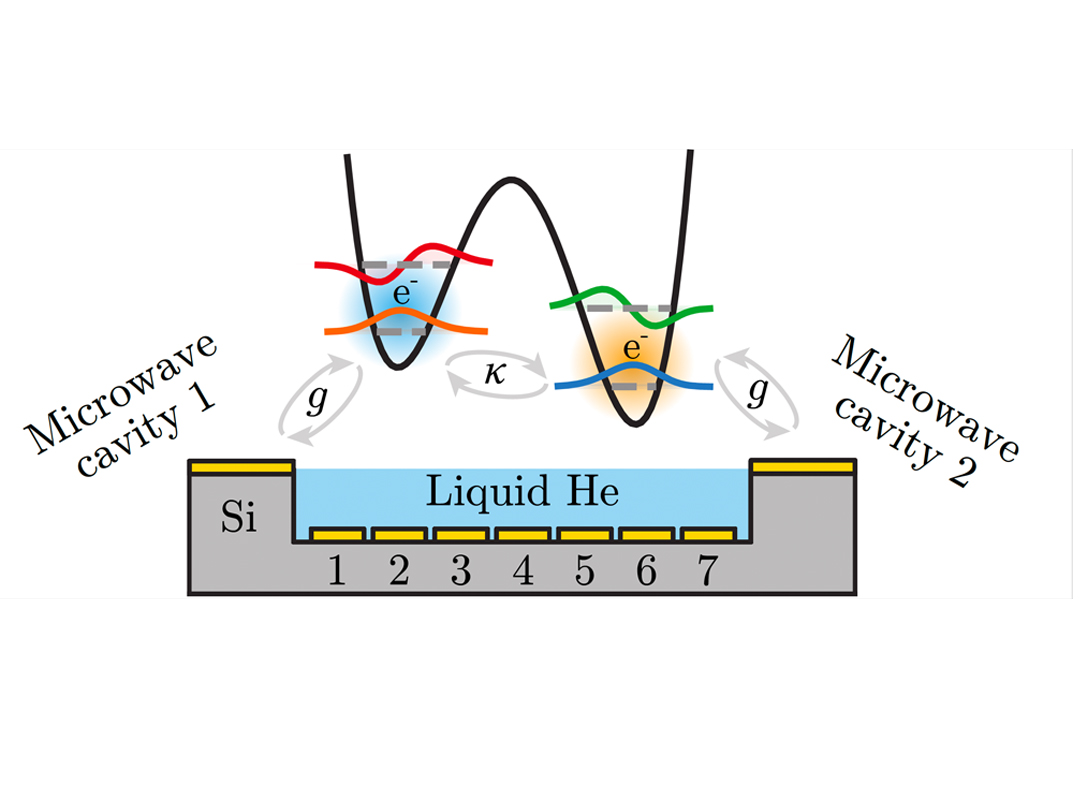
Systems of individual electrons electrostatically trapped on condensed noble gas surfaces have recently attracted considerable interest as potential platforms for quantum computing. The electrons serve as charge qubits in the system, and the purity of the noble gas surface protects the relevant quantum properties of each electron. Previous work has indicated that manipulation of a confining double-well potential for electrons on superfluid helium can generate entanglement suitable for two-qubit gate operations. In this work, we incorporate a time-dependent tuning of the potential shape to further explore operation of two-qubit gates with the superfluid helium system. Through numerical time evolution of the closed system (without decoherence), we show that control-induced errors can be minimized to allow for fast, high-fidelity two-qubit gates. In particular, we simulate operation of the iSWAP‾‾‾‾‾‾‾√ and CZ gates and obtain estimated fidelities of 0.999 and 0.996 with execution times of 2.9 ns and 9.4 ns, respectively. Furthermore, we examine the stability of these gate fidelities under non-ideal execution conditions, which reveals new properties to consider in the device design. Finally, we reflect on the impact of screening and decoherence on our results. The methodology presented here enables future efforts to isolate control-induced effects from environmental noise, which is an important step towards the realization of high-fidelity two-qubit gates with electrons on helium.
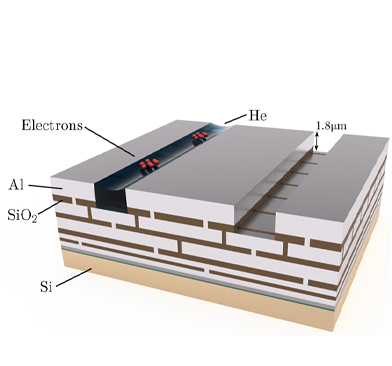
Abstract
Electrons bound to the surface of liquid helium are an emerging quantum computing platform, offering the potential for highly mobile spin qubits that can be manipulated using CMOS-fabricated devices. Here, as a step toward realizing this technology, we demonstrate selective two-dimensional shuttling of electrons across a helium film condensed on the surface of a CMOS control chip. The electrons are moved in packets containing, on average, several tens down to single electrons. We perform CCD-style electron shuttling in any of 128 transport microchannels, each of which links electron storage zones and sensing zones in the 2D plane. Shuttling sequences can be repeated at least 10⁹ times with no detectable electron loss. The device serves as a prototype quantum information processing platform that is readily scalable to control large monolithically integrated arrays of single electron spins.
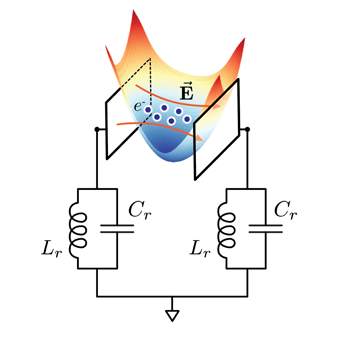
Abstract
Electrons trapped on the surface of cryogenic substrates (liquid helium, solid neon or
hydrogen) are an emerging platform for quantum information processing made attractive
by the inherent purity of the electron environment, the scalability of trapping devices and the
predicted long lifetime of electron spin states. Here we demonstrate the spatial control and
detection of single electrons above the surface of liquid helium at temperatures above 1 K. A
superconducting coplanar waveguide resonator is used to read out the charge state of an
electron trap defined by gate electrodes beneath the helium surface. Dispersive frequency
shifts are observed as the trap is loaded with electrons, from several tens down to single
electrons. These frequency shifts are in good agreement with our theoretical model that
treats each electron as a classical oscillator coupled to the cavity field. This sensitive charge
readout scheme can aid efforts to develop large-scale quantum processors that require the
high cooling powers available in cryostats operating above 1 K.
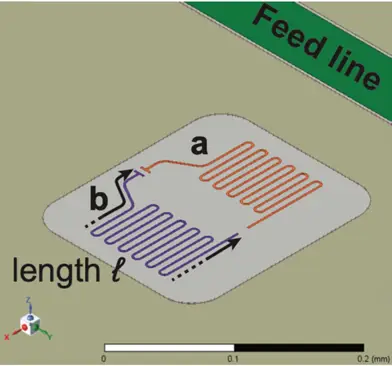
Abstract
The in-plane motion of an electron on helium can couple to superconducting microwave
resonators via electrical dipole coupling, offering a robust and rapid readout scheme. In
previous efforts, microwave resonator designs for electrons on helium have lacked the
coupling strength to reach the strong coupling regime, where coherent quantum effects
outlast both electron and resonator decoherence rates. High-impedance superconducting
microwave resonators offer a path to strong coupling, but integrating such resonators with
electrons on helium remains an outstanding challenge. Here, we introduce a
high-impedance resonator design compatible with strong coupling to electrons on helium.
We fabricate and measure titanium nitride resonators with median internal quality factors of
3.9 ×10⁵ and average impedance of 2.5 k Ω, promising a sevenfold increase in coupling
strength compared with standard 50-Ω resonators. In addition, we develop a simplified
resonator model from the capacitance matrix and sheet inductance that accurately predicts
the mode frequencies, significantly simplifying the design process of future resonators for
investigating quantum effects with electrons on helium.
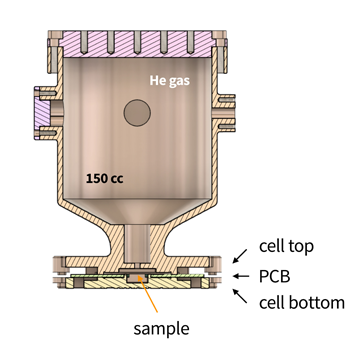
Abstract
We describe a helium source cell for use in cryogenic experiments that is hermetically sealed
in situ on the cold plate of a cryostat. The source cell is filled with helium gas at room
temperature and, subsequently, sealed using a cold weld crimping tool before the cryostat is
closed and cooled down. At low temperatures, the helium condenses and collects in a
connected experimental volume, as monitored via the frequency response of a planar
superconducting resonator device sensitive to small amounts of liquid helium. This
on-cryostat helium source negates the use of a filling tube between the cryogenic volumes
and room temperature, thereby preventing unwanted effects such as temperature
instabilities that arise from the thermomechanical motion of helium within the system. This
helium source can be used in experiments investigating the properties of quantum fluids or
to better thermalize quantum devices.
Foundational Science
Abstract
The generation and evolution of entanglement in many-body systems is an active
area of research that spans multiple fields, from quantum information science to the
simulation of quantum many-body systems encountered in condensed matter,
subatomic physics, and quantum chemistry. Motivated by recent experiments
exploring quantum information processing systems with electrons trapped above
the surface of cryogenic noble gas substrates, we theoretically investigate the
generation of motional entanglement between two electrons via their unscreened
Coulomb interaction. The model system consists of two electrons confined in
separate electrostatic traps that establish microwave-frequency quantized states of
their motion. We compute the motional energy spectra of the electrons, as well as
their entanglement, by diagonalizing the model Hamiltonian with respect to a
single-particle Hartree product basis. We also compare our results with the
predictions of an effective Hamiltonian. The computational procedure outlined here
can be employed for device design and guidance of experimental implementations.
In particular, the theoretical tools developed here can be used for fine-tuning and
optimization of control parameters in future experiments with electrons trapped
above the surface of superfluid helium or solid neon.
Abstract
In this review, we introduce a developing qubit platform: floating-electron-based
qubits. Electrons floating in a vacuum above the surface of liquid helium or solid
neon emerge as promising candidates for qubits, especially due to their expected
long coherence times. Despite being in the early stages, a variety of recent
experiments from different groups have shown substantial potential in this role. We
survey a range of theoretical proposals and recent experiments, primarily focusing
on the use of the spin state as the qubit state, wherein the spin and charge states
are hybridized. Throughout these proposals and experiments, the charge state is
coupled to an LC resonator, which facilitates both the control and readout
mechanisms for the spin state via an artificially introduced spin–charge coupling.
Abstract
Electrons on helium form a unique two-dimensional system on the interface of liquid
helium and vacuum. A small number of trapped electrons on helium exhibits strong
interactions in the absence of disorder, and can be used as a qubit. Trapped
electrons typically have orbital frequencies in the microwave regime and can
therefore be integrated with circuit quantum electrodynamics (cQED), which studies
light–matter interactions using microwave photons. Here, we experimentally realize a
cQED platform with the orbitals of single electrons on helium. We deterministically
trap one to four electrons in a dot integrated with a microwave resonator, allowing us
to study the electrons’ response to microwaves. Furthermore, we find a
single-electron-photon coupling strength of g/2 \pi = 4.8 MHz, greatly exceeding the
resonator linewidth \kappa /2 \pi =0.5 MHz. These results pave the way towards
microwave studies of Wigner molecules and coherent control of the orbital and spin
state of a single electron on helium.
Abstract
We propose a hybrid architecture in which an on-chip high finesse superconducting
cavity is coupled to the lateral motion and spin state of a single electron trapped on
the surface of superfluid helium. We estimate the motional coherence times to
exceed 15 \u s, while energy will be coherently exchanged with the cavity photons in
less than 10 ns for charge states and faster than 1 \u s for spin states, making the
system attractive for quantum information processing and strong coupling cavity
quantum electrodynamics experiments. The cavity is used for nondestructive
readout and as a quantum bus mediating interactions between distant electrons or
an electron and a superconducting qubit.
Abstract
Unprecedented transport efficiency is demonstrated for electrons on the surface of
micron-scale superfluid helium-filled channels by co-opting silicon processing
technology to construct the equivalent of a charge-coupled device. Strong fringing
fields lead to undetectably rare transfer failures after over a billion cycles in two
dimensions. This extremely efficient transport is measured in 120 channels
simultaneously with packets of up to 20 electrons, and down to singly occupied
pixels. These results point the way towards the large scale transport of either
computational qubits or electron spin qubits used for communications in a hybrid
qubit system.
Abstract
Numerous physical systems have been proposed for constructing quantum
computers, but formidable obstacles stand in the way of making even modest
systems with a few hundred quantum bits (qubits). Several approaches utilize the
spin of an electron as the qubit. Here it is suggested that the spin of electrons floating
on the surface of liquid helium will make excellent qubits. These electrons can be
electrostatically held and manipulated much like electrons in semiconductor
heterostructures, but being in a vacuum the spins on helium suffer much less
decoherence. In particular, the spin-orbit interaction is reduced so that moving the
qubits with voltages applied to gates has little effect on their coherence. Remaining
sources of decoherence are considered, and it is found that coherence times for
electron spins on helium can be expected to exceed 100 s . It is shown how to obtain
a controlled-NOT operation between two qubits using the magnetic dipole-dipole
interaction.
Abstract
We study dissipation effects for electrons on the surface of liquid helium, which may
serve as the qubits of a quantum computer. Each electron is localized in a 3D
potential well formed by the image potential in helium and the potential from a
submicron electrode submerged into helium. We estimate parameters of the
confining potential and characterize the electron energy spectrum. Decay of the
excited electron state is due to two-ripplon scattering and to scattering by phonons
in helium. We identify mechanisms of coupling to phonons. An estimate of
contributions from different scattering mechanisms shows that the decay rate
should be ≲104 s−1. We analyze dephasing of the electron states due to quasielastic
ripplon scattering off an electron. The dephasing rate is ≲102 s−1 for 𝑇 = 10 mK and
depends on temperature as 𝑇3. Decay and decoherence of the electron states result
also from classical and quantum electrode noise. We relate the corresponding
relaxation rates to the power spectrum of the fluctuating electric field on the
electron. The dependence of the rates on the electrode parameters is obtained.
Abstract
A quasi–two-dimensional set of electrons (1 < 109) in vacuum, trapped in
one-dimensional hydrogenic levels above a micrometer-thick film of liquid helium, is
proposed as an easily manipulated strongly interacting set of quantum bits.
Individual electrons are laterally confined by micrometer-sized metal pads below the
helium. Information is stored in the lowest hydrogenic levels. With electric fields, at
temperatures of 10−2 kelvin, changes in the wave function can be made in
nanoseconds. Wave function coherence times are 0.1 millisecond. The wave function
is read out with an inverted dc voltage, which releases excited electrons from the
surface.