
Long-Range Electron Entanglement Offers a Path to More Reliable Quantum Gates
Chicago, IL – April 1, 2026 – A paper published today in Physical Review A by researchers from the University of Oslo, Michigan State University and EeroQ Corporation introduces a new scheme for entanglement between two electrons that remain relatively far apart. The theoretical study evaluates the performance of quantum gate operations by pinpointing key sources of error. It also presents an effective method for mitigating those errors.
Quantum computing using electron spins typically relies on bringing electrons extremely close together so that their quantum mechanical wavefunctions begin to overlap. The electrons can then become locked together in a single quantum state, a phenomenon known as quantum entanglement. While achieving entanglement is key to unleashing the power of quantum information processing, it presents a significant technical challenge due to the tiny length scales (~100 nanometers) over which electrons must be controlled.
Alternatively, quantum information can be encoded in the motion of a trapped electron, rather than its spin. Electrons carry a negative charge; the repulsive force (or ‘Coulomb interaction’) between neighboring electrons causes the motion of one electron to influence the other, which also leads to entanglement. To generate entanglement, a series of control gates, each driven by an applied voltage, is typically used to tune the separation between electrons. However, changing these voltages doesn’t just do what we want – it also, unintentionally, shifts the electrostatic environment the electrons experience. Those unintended shifts introduce errors that can reduce the reliability of quantum operations.
Coulomb interaction influences electron behavior in all nanoscale electronics, including the semiconductor quantum dot devices used to create most of today’s spin qubit devices, the interaction strength is reduced by the presence of the host material (a phenomenon known as screening).
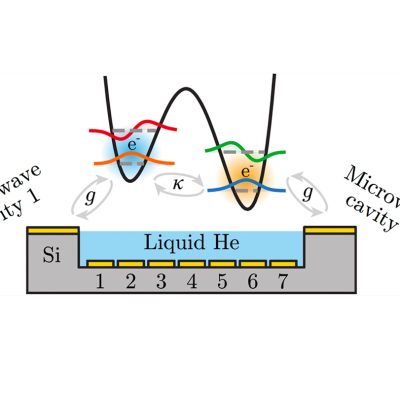
Schematic of the studied microdevice layout, in which two electrons are trapped on the surface of a liquid helium basin in an electrostatic double-well potential created by control electrodes.
However, the unique electron system used at EeroQ provides a solution: by moving electrons out of the host material and onto the surface of a thin helium layer coating the control chip, the interaction between the electrons becomes almost completely unscreened. This makes the electron-on-helium system ideal for realizing the ideas developed in this new work.
Long-range Coulomb interaction provides a compelling method for qubit entanglement; it is well known that electron motional qubits suffer more from environmental noise than their spin counterparts. For this reason, the qubits being developed at EeroQ use the electron spin for encoding quantum information. However, understanding the Coulomb interaction which influences electrons-on-helium so strongly, remains important.
“Alongside the significant progress at EeroQ in developing spin qubits with electrons on the surface of helium, the new results we present in this paper show there is still much to explore with this system,” EeroQ’s Director of Quantum Engineering and co-author, Dr. Niyaz Beysengulov stated. “Controlling the different quantum degrees of freedom of our qubits is at the heart of all of EeroQ’s research, and Coulomb-mediated electron entanglement can be another useful addition to our quantum toolkit.”
This paper is also on arXiv, click here!