EeroQ develops new microwave resonators for our future quantum processors
February 17, 2025
EeroQ develops new microwave resonators that will improve readout speed and accuracy on our future quantum computers
Any quantum computer requires both physical quantum information carriers – the qubits – and the technology to measure the qubits. Because useful quantum algorithms require thousands of readout cycles, running those algorithms in a timely and accurate manner requires fast and high-fidelity qubit readout, with complete control over the readout mechanism.
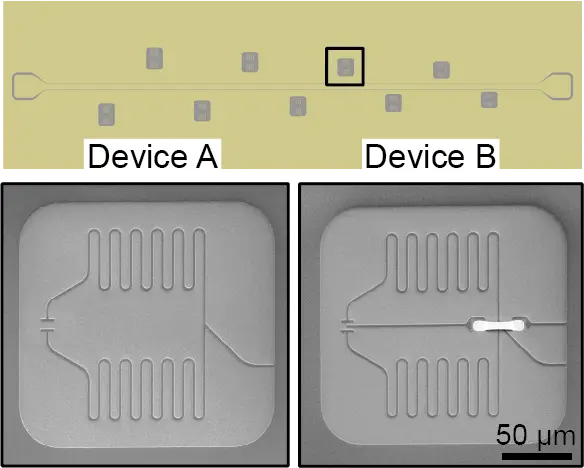
At EeroQ, we have made a series of breakthroughs in engineering the readout devices used to access the quantum properties of electrons-on-helium. In an article published this month in Physical Review Applied, we design and test microwave readout resonators specifically engineered to be compatible with our CMOS-based quantum platform. The resonator geometry integrates seamlessly with our silicon-based single-electron trapping devices. Importantly, we fabricated the resonators using titanium nitride, a superconductor with a special material property called kinetic inductance that is predicted to substantially boost electron measurement speed compared to previous approaches [1]. In addition to their excellent microwave properties, the microwave responses of our resonators are accurately predicted to within 2% by our calculations, proving the validity of our theoretical models and the reliability of our fabrication methods.
The novel techniques developed in this work, done in collaboration with University of Chicago and Stanford University, range from nanofabrication to simulation and theory. We now actively incorporate this technology into the single-electron trapping measurements that we carry out daily at our Chicago headquarters.
AI-generated artistic rendering of electron trapped on liquid helium using a CMOS device
Using microwave resonators for readout is a powerful tried-and-tested approach. In the 2000s, advances in an area of physics known as circuit quantum electrodynamics (cQED for short) allowed man-made electrical circuits to be built that behaved according to the rules of quantum mechanics. These advances kickstarted the current revolution in quantum computing technologies. Put simply, cQED uses microscopic circuits (resonators) to probe qubits via the exchange of microwave energy. By monitoring the output of a resonator using commercially available electronics, it became straightforward to deduce information about the qubit. In short, cQED makes it possible for quantum information processing to be fast, accurate, and space-efficient, all of which are crucial for building useful and scalable quantum computers.
EeroQ is building on the long tradition of cQED. With our new microwave resonators and our full theoretical understanding of resonator-electron interactions in our tool belt, we have a clear path to measuring electrons on helium with higher accuracy and speed than ever before.
Scanning electron micrograph of EeroQ’s new microwave resonator devices fabricated using titanium nitride on a silicon chip. Device A: The bare resonator structure. Device B: An additional realization of the resonator, which contains a mock electrode and aluminum air bridge to mimic the structures needed for single-electron trapping. The resonators boast a small footprint and the presence of additional electrode structures does not negatively affect their performance.
What’s more, because electrons are easily moved around our chips, a single one of our resonators can be used to read out many separate electron qubits, greatly reducing the number of physical readout devices needed per quantum computer. Combined with the inherent scalability and all-to-all connectivity of the electrons-on-helium system, EeroQ continues to make strides with our innovative approach to quantum computing.
Lorem ipsum dolor sit amet consectetur adipiscing elit dolor. sit amet consectetur adipiscing elit dolor. Lorem ipsum dolor sit amet consectetur adipiscing elit dolor. sit amet consectetur adipiscing elit dolor
Lorem ipsum dolor sit amet consectetur adipiscing elit dolor. sit amet consectetur adipiscing elit dolor. Lorem ipsum dolor sit amet consectetur adipiscing elit dolor. sit amet consectetur adipiscing elit dolor
Lorem ipsum dolor sit amet consectetur adipiscing elit dolor. sit amet consectetur adipiscing elit dolor. Lorem ipsum dolor sit amet consectetur adipiscing elit dolor. sit amet consectetur adipiscing elit dolor
Lorem ipsum dolor sit amet consectetur adipiscing elit dolor. sit amet consectetur adipiscing elit dolor. Lorem ipsum dolor sit amet consectetur adipiscing elit dolor. sit amet consectetur adipiscing elit dolor
Lorem ipsum dolor sit amet consectetur adipiscing elit dolor. sit amet consectetur adipiscing elit dolor. Lorem ipsum dolor sit amet consectetur adipiscing elit dolor. sit amet consectetur adipiscing elit dolor