Cryogenic helium source eliminates headaches associated with superfluid engineering and reduces liquid helium oscillations that could decohere our future scalable quantum computer
Traditionally, helium is delivered to experimental cells via permanently installed filling tubes that enter from the outside of the cryostat and run down to the lowest temperature stage. These tubes act as a link between room temperature and the coldest part of the cryostat and tend to introduce noise detrimental to the electron motional state. For example, residual helium trapped in a filling tube may give rise to thermal instabilities and generate oscillations in the helium bath on which the electrons float. In the world of quantum computing, these unwanted perturbations are known as decoherence sources and cause quantum states to lose information. The noise sources introduced by filling tubes may have been a critical roadblock to boosting the electron motional state coherence in previous measurements [1]. In addition to these unwanted effects, installing a filling tube can be downright painful. Brazing and installing small components in cramped cryostats can be arduous and, because superfluids leak through the tiniest of holes, leaks are often only detected when the cryostat reaches its base temperature.
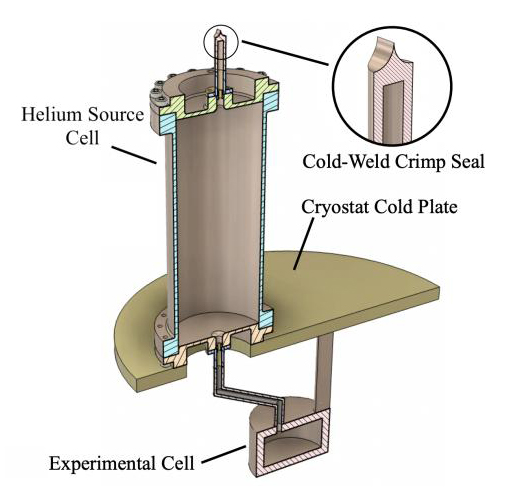
At EeroQ, we have engineered a helium source that is installed onto the cryostat’s coldest stage. The source is a miniature copper gas tank that is connected to the experimental cell via a short tube. It is pre-charged with a calibrated amount of helium gas at room temperature and is cooled down with the experimental cell as a single unit. Once cold enough, the helium condenses into its superfluid state, filling the microchannel devices we use to trap and study the motional states of single electrons. We are excited to announce that this work was recently published in the Review of Scientific Instruments [2].
EeroQ’s innovative helium source has the potential to replace traditional filling tubes. In our recent publication, we benchmarked the helium source performance and demonstrated that it can eliminate fluctuations in the cryostat temperature that are typically associated with filling tubes. We see this work as an important step towards spin readout of single electrons on helium, and are actively integrating our helium source technology with other exciting advances to engineer the world’s first electron-on-helium-based quantum processor.
Citations:
[1] Koolstra, et al. “Coupling a single electron on superfluid helium to a superconducting resonator.” Nat. Commun. 10, 5323 (2019).
[2] Castoria, et al., “A hermetic on-cryostat helium source for low temperature experiments.” Rev. Sci. Instrum. 95, 043902 (2024).